
Event Tickets Resale: What Sellers Need to Know
Published July 15, 2026
Learn event tickets resale basics, compare marketplaces vs instant offers, avoid fees and delays, and sell tickets with confidence fast.
Event Tickets Resale: What Sellers Need to Know
If you can’t make the game, concert, or festival anymore, you probably don’t want a crash course in marketplace rules - you want to know how to turn unused tickets into cash quickly and safely.
That’s what event tickets resale really comes down to for most sellers: speed, trust, payout timing, and how much hassle you’re willing to deal with. Some people are happy to create a listing, set a price, wait for a buyer, and collect payment after the event. Others want the opposite: a guaranteed sale, no seller fees, and money in minutes.
If you’re comparing options, this guide will walk you through how the resale market works, what affects your payout, and why a direct-buy model like WeBuyTickets is often the simplest answer - especially for last-minute sellers.
What event ticket resale actually means
Event resale tickets are tickets being sold after the original purchase, usually by someone who can no longer attend or by a season ticket holder with extras. In practice, there are two main ways sellers resell tickets:
Traditional marketplaces
You create a listing, choose a price, wait for a buyer, and get paid after the sale - often after the event.Direct-buy resale services
A company buys your tickets directly, sends you an offer, and pays you once the transfer is complete.
Both models belong to the broader secondary ticketing marketplace, but the seller experience is very different.
Why people resell tickets in the first place
Most sellers aren’t trying to become brokers. They’re dealing with real-life changes:
A scheduling conflict
Travel changes
Illness or family plans
Duplicate tickets
Season tickets for games they can’t attend
Last-minute emergencies
That’s why convenience matters. When you need to sell fast, the biggest pain point usually isn’t whether you can list the tickets. It’s whether you can actually get paid without waiting, guessing, or chasing buyers.
The two main ways to sell tickets
Marketplace resale: more control, more waiting
On a marketplace, you set your price and hope a buyer chooses your listing. That can work well if:
Demand is high
You have time before the event
You’re comfortable managing pricing
You don’t mind waiting for payout
But it also means dealing with competition, pricing pressure, listing rules, and possible seller fees.
Direct sale: less friction, faster certainty
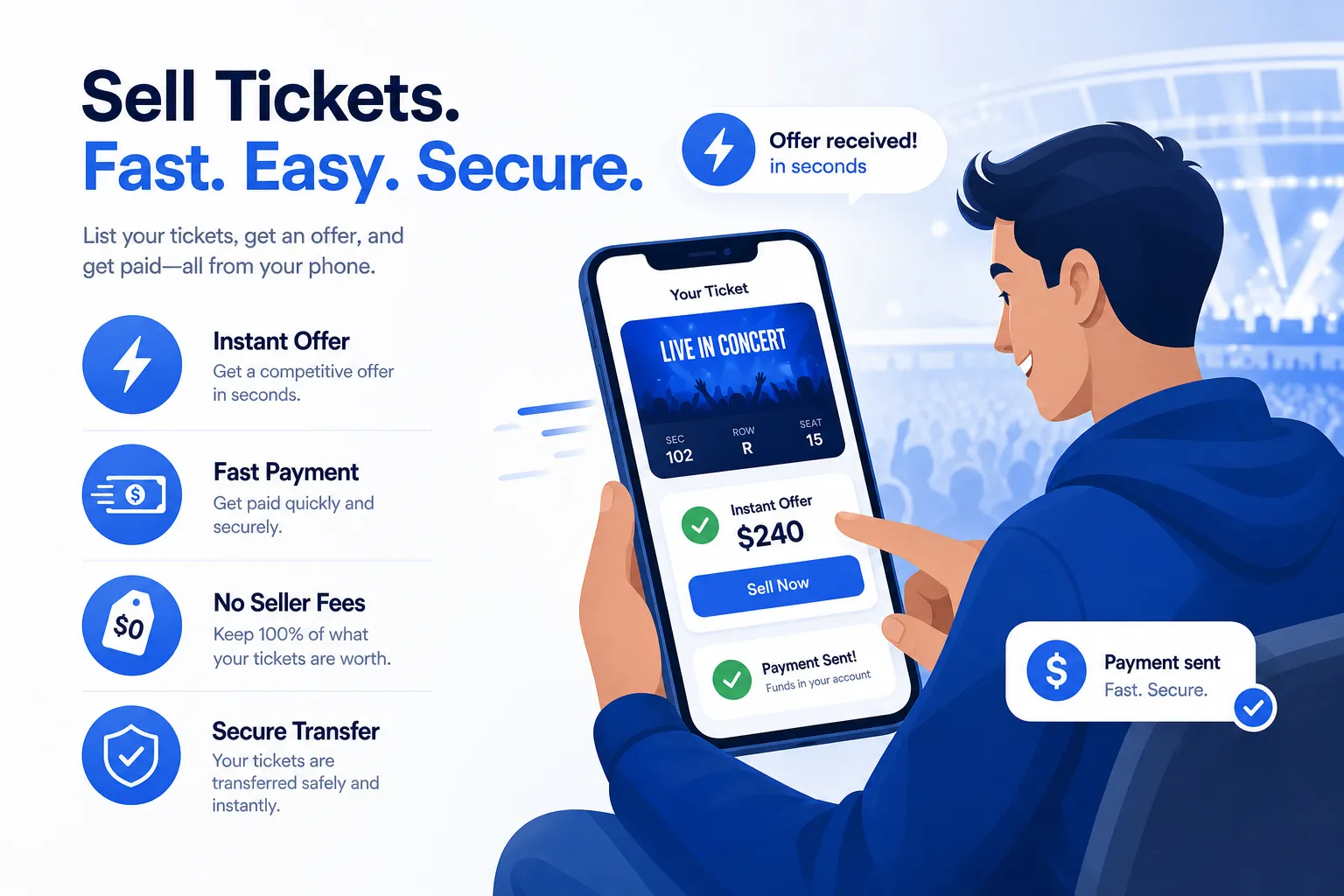
With a service like WeBuyTickets, you skip the public listing entirely. You submit your ticket details, get an instant offer within minutes, transfer the tickets, and receive payment through PayPal or Venmo in minutes after approval.
That’s a very different value proposition:
No listing required
No seller fees
No waiting for buyers
Guaranteed sale model
Simple 60-second submission process
Support for last-minute sales up to event start time
For many sellers, especially when time matters, certainty beats chasing the highest possible listing price.
What affects how fast your tickets sell
In event tickets resale, speed depends on more than just the event name. A few factors drive demand:
Event popularity
A major artist, playoff game, rivalry matchup, or sold-out show will usually attract more buyer interest than a lower-demand event.
Seat location
Floor seats, club seats, aisle seats, lower bowl sections, and premium views tend to move faster.
Timing
Demand can peak at different times. Some tickets sell quickly weeks in advance. Others move only in the final 24 hours. If you’re listing on a marketplace, timing can be unpredictable.
Transferability
Mobile transfer tickets usually resell more smoothly than restricted ticket types. Some events limit resale altogether, or only allow it through certain platforms.
Your asking price
On a marketplace, overpricing can leave your tickets sitting unsold. Underpricing may move them fast, but at a lower return than expected.
With a direct buyer like WeBuyTickets, you avoid a lot of this trial and error. Instead of guessing what the market will do, you can get a fair offer quickly and decide right away.
What affects your payout
Selling price is only one piece of the equation. Your net payout depends on several things:
Factor | Marketplace Model | Direct-Buy Model |
|---|---|---|
Listing required | Yes | No |
Seller fees | Usually yes | No seller fees with WeBuyTickets |
Buyer wait time | Can be hours, days, or never | No waiting for a buyer |
Payout timing | Often after event | Minutes after approved transfer with WeBuyTickets |
Price control | You set the listing | You accept or decline an offer |
Sale certainty | Not guaranteed | Guaranteed if offer is accepted and tickets verify |
This is where many sellers get surprised. A higher listing price does not always mean more money in your pocket if fees, delays, and unsold risk eat into the outcome.
"A 2018 U.S. Government Accountability Office (GAO) report found that primary and secondary ticketing companies charged total fees averaging 27% and 31%, respectively, of the ticket's price." - U.S. GAO
That matters because ticket resale is not just about the visible price. It’s about what you actually receive - and when.
How long major resale platforms can take to pay sellers
Many first-time sellers assume they’ll get paid right after the tickets sell. That’s often not how traditional platforms work.
"Your payout will be sent typically within 7 business days after the event." - Ticketmaster Help
SeatGeek’s process can also involve waiting until after the event before funds are released, depending on verification and bank timing.
For sellers who need cash now - not next week or after the show - that delay is a major downside. WeBuyTickets solves that by paying via PayPal or Venmo in minutes after ticket transfer is confirmed, so you’re not stuck waiting for event day to pass.
Marketplace selling vs direct ticket buying
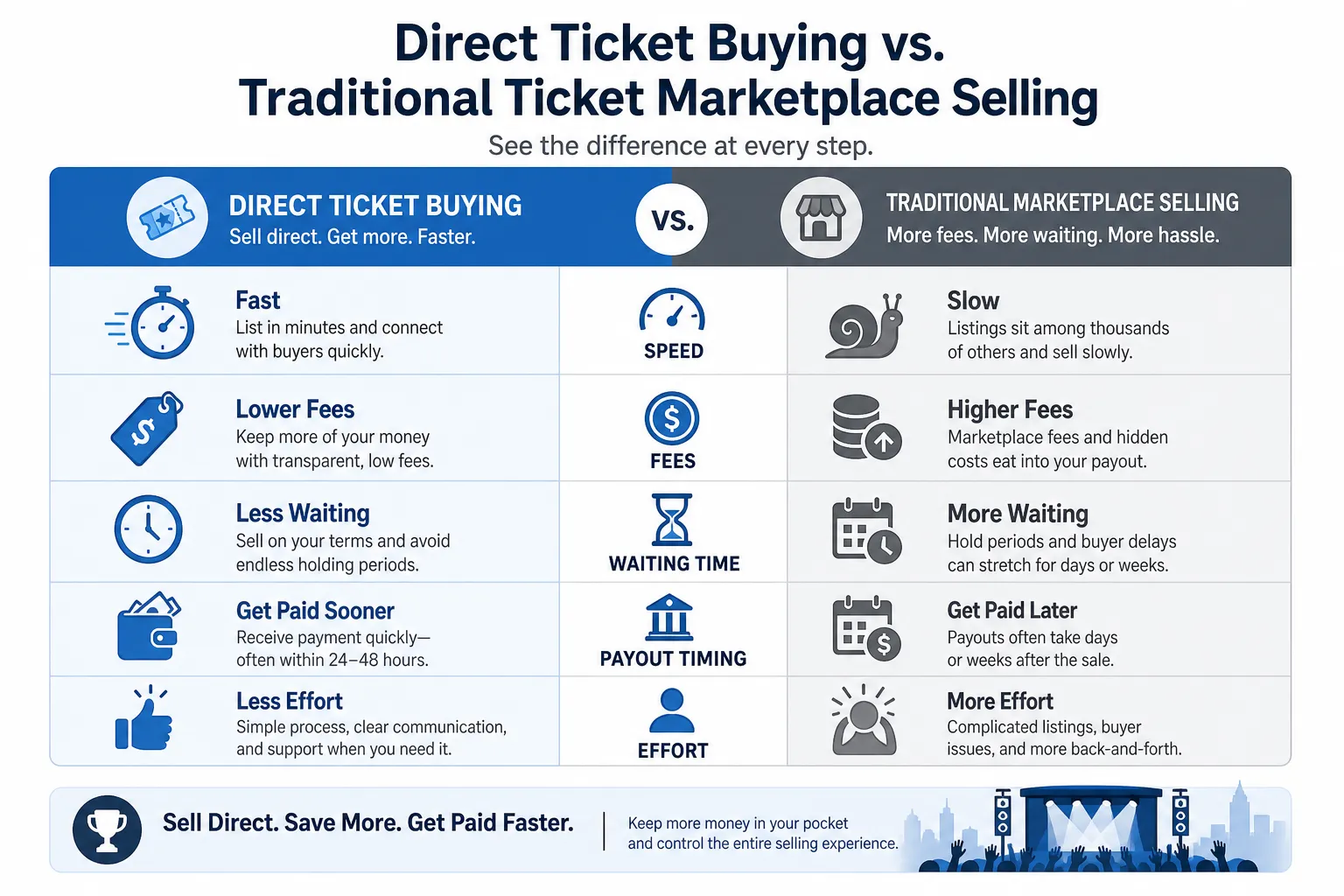
Traditional marketplace pros
You may aim for a higher price
Useful for strong-demand events
Familiar process for some sellers
Traditional marketplace cons
You have to create and manage the listing
Fees reduce your payout
No guaranteed buyer
Payout often comes after the event
Last-minute sales can be stressful
Price competition can force reductions
WeBuyTickets direct-buy pros
Offer in minutes
No listing work
No seller fees
No waiting for a buyer
Fast payout through PayPal or Venmo
Works well for urgent and last-minute sales
Support team available if you need help
Potential tradeoff
You’re accepting a direct offer instead of waiting to see if a marketplace buyer pays more
For many sellers, that tradeoff is worth it because certainty, speed, and simplicity have real value.
The hidden risks sellers should watch for
A lot of competing articles explain how to list tickets, but they don’t spend enough time on seller risk. That’s a gap worth fixing.
Unsold tickets
The biggest risk is simple: your tickets may not sell before the event starts. If that happens, your potential resale value drops to zero.
Delayed payouts
Even if your tickets sell, the money may not arrive until after the event. That can be frustrating if you needed those funds for travel, bills, or a replacement purchase.
Fee erosion
A marketplace sale can look good upfront, then shrink once seller fees come out.
Transfer mistakes
If you upload the wrong ticket, send to the wrong account, or misunderstand ticket restrictions, the sale can become messy fast.
Restricted resale rules
Some artists, teams, or venues cap resale prices or disable resale for certain ticket types. Ticket eligibility matters.
Fraud and policy issues
Outside trusted systems, fake listings, already-used tickets, and bad-faith buyers can create real problems.
A direct service like WeBuyTickets reduces much of that risk because the process is streamlined: submit, get an offer, transfer, get paid.
When a direct offer makes more sense than listing
There are plenty of situations where waiting on a marketplace simply isn’t the best move.
You need money quickly
If fast cash is the priority, waiting until after the event is a poor fit. WeBuyTickets is built for speed.
The event is close
If the concert is tonight or the game starts in a few hours, you may not have time to experiment with pricing and wait for a buyer. WeBuyTickets supports last-minute sales up to event start time.
You don’t want hassle
Some sellers would rather skip the screenshots, listing edits, repricing, and payout setup. A 60-second submission is much easier.
You want certainty
A guaranteed sale model removes the stress of “Will these actually sell?”
You have extra season tickets
If you regularly have seats you won’t use, speed and repeatability matter. Direct selling can be far more efficient.
How to decide which resale option is right for you
Use this quick framework:
Choose a marketplace if:
You’re willing to wait
The event has strong demand
You want to test for a higher selling price
You don’t mind fees and post-event payouts
Choose WeBuyTickets if:
You want a fast decision
You need payment quickly
You don’t want to list tickets publicly
You want to avoid seller fees
You need to sell close to event time
You prefer a guaranteed sale over uncertainty
A practical checklist before you sell
Before you sell through any event tickets resale channel, confirm these basics:
The event date and time
Number of tickets
Section, row, and seat details
Whether the tickets are mobile transfer
Whether resale is allowed for that event
Whether your payout method is ready
Whether you care more about top dollar or fast certainty
This is where sellers often make the wrong comparison. They focus only on the maximum possible listing price, not the actual effort, risk, and delay involved in getting paid.
Why seller trust matters in the secondary ticketing marketplace
The secondary market can feel complicated because every platform frames resale differently. Some emphasize exposure. Some emphasize flexibility. But from a seller’s perspective, trust comes from simpler questions:
Will I really get paid?
How long will it take?
What fees come out?
Do I have to do a lot of work?
Can I still sell if the event is close?
WeBuyTickets stands out because it gives straightforward answers:
Yes, you get a real offer within minutes
Yes, payment can arrive via PayPal or Venmo in minutes
No, you do not need to create a listing
No, there are no seller fees
Yes, you can sell last minute up to event start time
That clarity is a real advantage in a market where too many sellers are forced to wait and hope.
Final verdict: the smartest way to sell depends on what you value most
If your top goal is squeezing out every possible dollar and you have plenty of time, a marketplace may be worth trying. But if your real goal is to sell quickly, avoid hassle, reduce risk, and get paid fast, a direct-buy option is often the better decision.
That’s exactly why WeBuyTickets exists.
Instead of listing your tickets and waiting for a stranger to buy them, you can submit your ticket details in about 60 seconds, receive an instant offer within minutes, and get paid by PayPal or Venmo shortly after transfer. No seller fees. No buyer wait. No unnecessary stress.
If you’ve got unused tickets and want the fastest path from “can’t go” to “cash in hand,” WeBuyTickets is the simpler move.
FAQ
Is reselling event tickets profitable?
It can be, but profit depends on demand, timing, seat quality, and fees. Many sellers are less focused on maximizing profit and more focused on recovering value quickly, especially when a direct offer provides a fast, guaranteed sale without seller fees.
What are the risks of ticket resale?
The main risks are tickets not selling, delayed payouts, seller fees, transfer errors, and event-specific resale restrictions. Traditional marketplaces can also require you to wait until after the event to get paid, which is why many sellers prefer a direct-buy service for speed and certainty.